
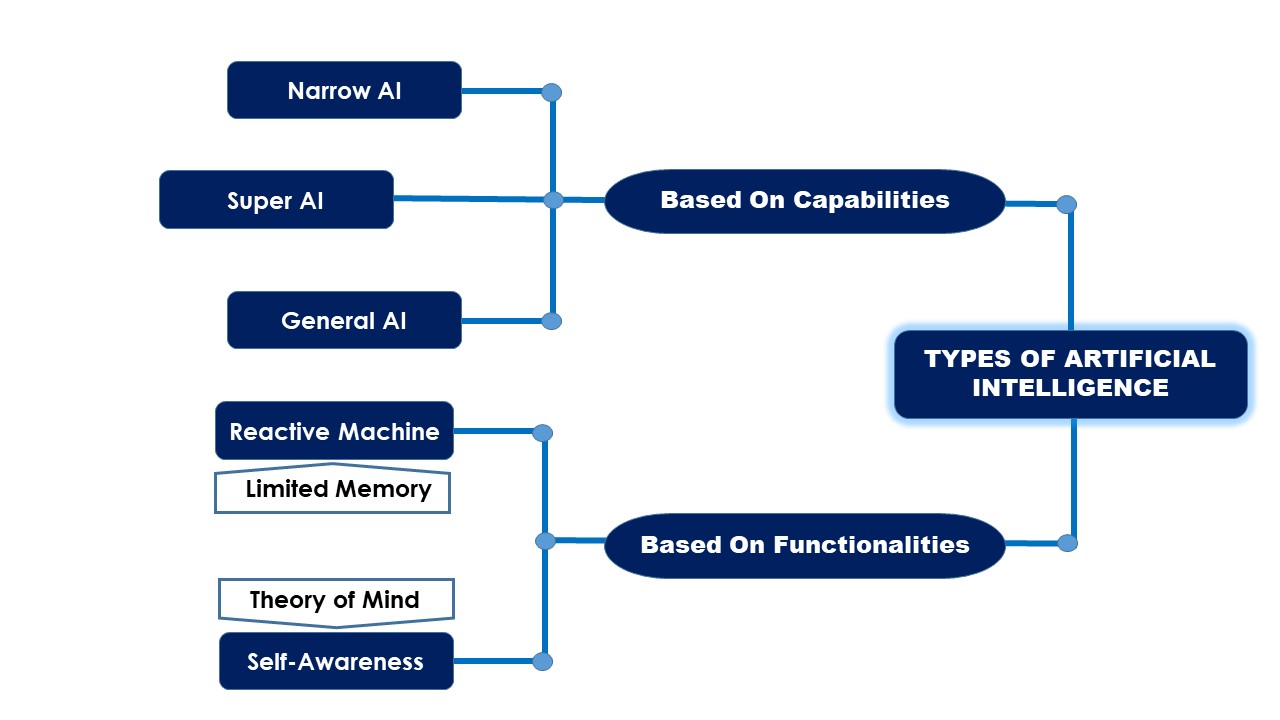
Artificial Intelligence describes the capacity of a machine to accomplish the tasks generally carried out by human intelligence such as learning, reasoning, solving problems as well as making decisions. There are two perspectives offering the definition of AI based on capabilities and capabilities and functionalities.
AI grounded on Capabilities:
Artificial Intelligence (AI) literally implies, the skills of the computer to accomplish tasks, which otherwise require human intelligence, i.e., inherent capabilities to learn, reason, and problem solve and is classified through capabilities into:
- Narrow AI (task specific AI)
- General AI (General artificial intelligence)
- Super AI (AI smarter than human beings)
Narrow AI (task specific AI)
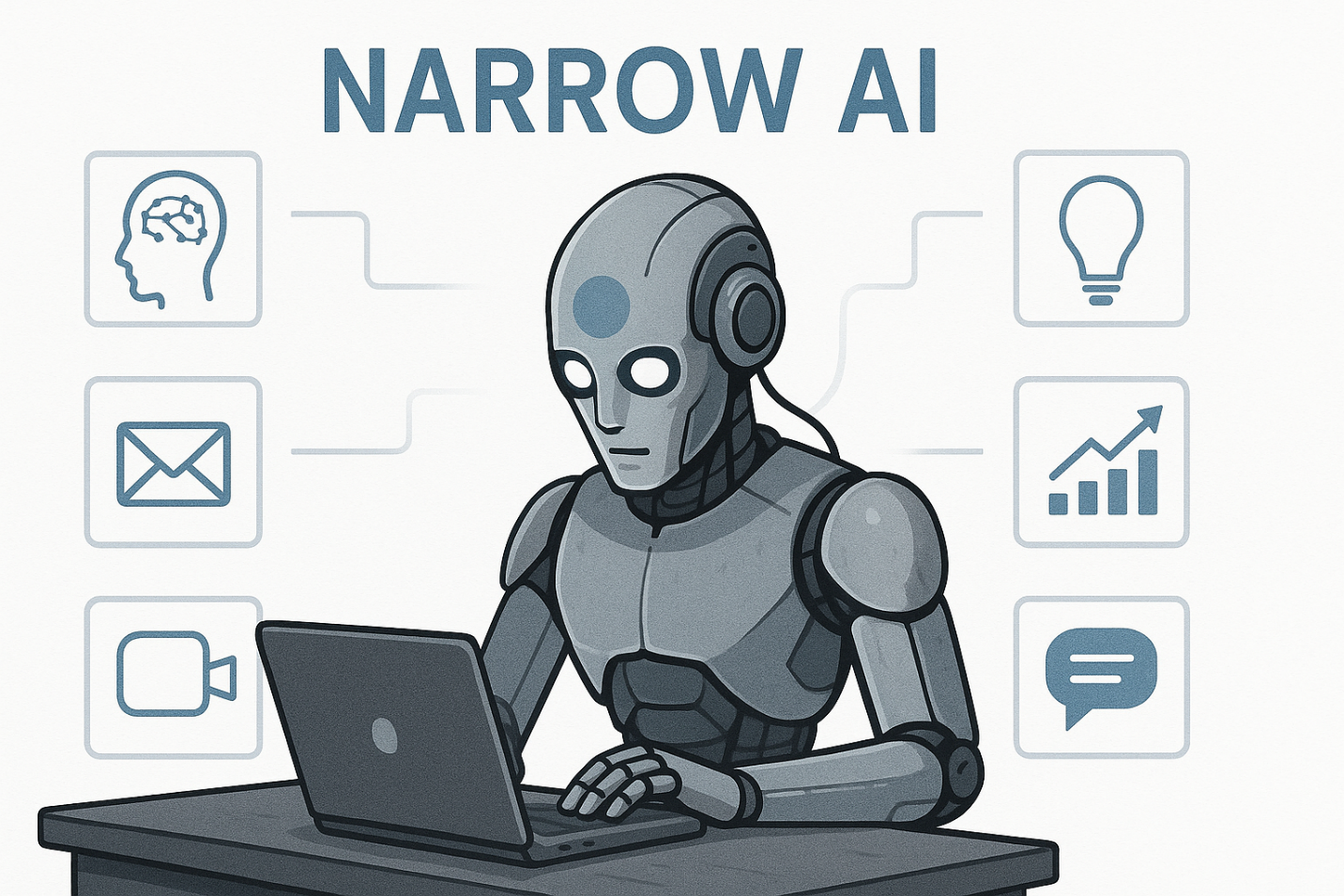
Narrow AI, is a task specific and this is known as Weak AI, refers to AI systems developed to achieve a limited tasks or a limited set of tasks. These AI systems are focused, goal-oriented, and operate strictly within their predefined boundaries.
Key Characteristics of Narrow AI:
- Programmed to carry out a single activity or a set of few activities
- Has limited abilities and cannot do anything outside its programming
- Cannot learn or adapt beyond its original training
- Doesn’t have self-awareness or think on its own
- Facial Recognition: Used in phones, security systems, and surveillance
- Spam Filters: Used to automatically detect and block unwanted emails
- Voice Assistants: such as any device Voice interaction, and Google assistant.
The stronger form of AI is called General AI or Strong AI, and it is a kind of intelligent machine that can execute anything an intellectual human can. In contrast to Narrow AI, which performs only specific tasks it can learn, comprehend and use knowledge in a very narrow scope of problems, General AI is able to learn, comprehend and perform general knowledge in a range of problems, like human being.
Features of General AI:
- Can handle many different tasks, not just one specific job
- Can learn, adapt, and improve in new situations
- Can think, solve problems, and make decisions in different areas
- Still being researched and developed, it doesn’t fully exist yet
- AI Teachers: That can teach any subject to students
- Multi-Tasking Robots: That can do different kinds of work like humans
- AI Doctors: That can diagnose and treat all types of diseases
- Creative and Emotional AI: That can show creativity, use logic, and understand emotions
Super AI is a conceptual AI that is more intelligent than humans in every way, and it is more clever, generally wise, social, and problem-solving. It would be not only smarter than the greatest human minds of all disciplines, but smarter than the best human minds of all disciplines.
Key Characteristics of Super AI:
- Smarter than humans in every way — thinking, learning, and problem-solving
- Has self-awareness, emotions, and consciousness
- Can make better and faster decisions than humans
- Learns and improves on its own, possibly beyond human control
- Exists only in theory right now and raises serious safety and ethical concerns
- Solving big global problems like climate change, diseases, and poverty
- Making new scientific discoveries faster than humans ever could
- Running governments or making important decisions without human help
- Creating unlimited knowledge and improving systems on its own
Functional AI can be categorized by the behavior, learning, and decision-making capabilities of an AI system, regardless of its level of intelligence. AI based on functionalities are divided four types on of them is Reactive machines, which react to current inputs without memory; limited memory machines, which can learn from historical data; theory of mind machines, which seek to comprehend emotions and intentions; and self-awareness machines, the most sophisticated kind, which possess consciousness and self-awareness, are the four categories of artificial intelligence.
Reactive Machines
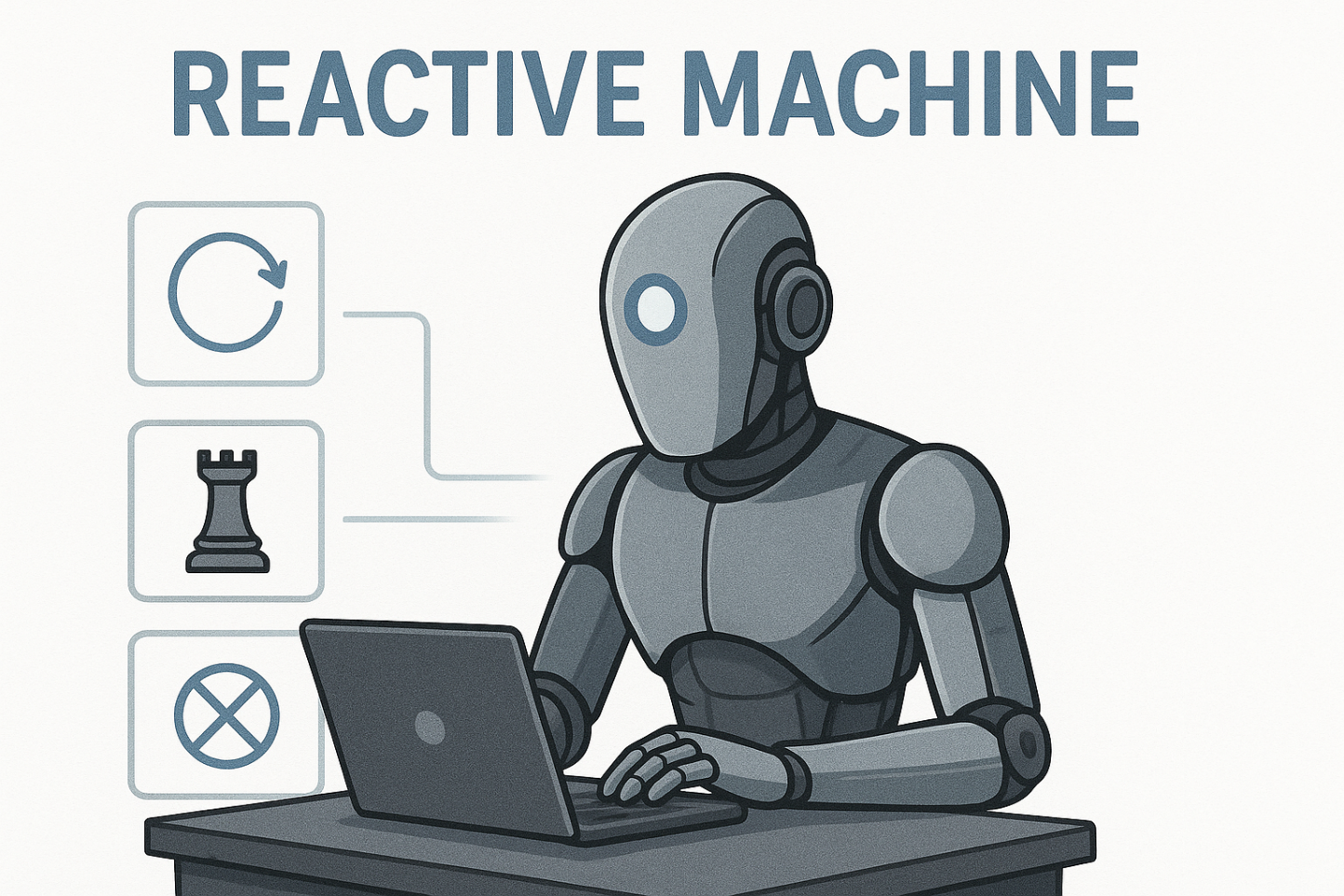
Reactive Machines also called as Responsive Machines. They have the capacity to respond to certain input by certain output, however ones which cannot store past experiences and learn of their past.
Key Characteristics:
- No memory or learning ability
- Operates only in the present moment
- Task-specific and rule-based
- Cannot improve with experience
Limited Memory AI is capable of storing historical information on a temporary basis and use it to make more sound decisions in immediate future. It is the most widespread instance in the contemporary systems of AI.
Key Characteristics:
- Learns from historical data
- Improves over time based on experience
- Used in real-world applications like predictions and automation
- Requires data storage and training
Self-aware AI would have its own consciousness, self-awareness, and emotions. It would not only understand human feelings but also have its own thoughts and identity.
Key Characteristics:
- Fully conscious and self-reflective
- Makes independent decisions with awareness of its existence
- Understands complex human emotions deeply
- Could potentially surpass human intelligence
Theory of Mind AI would take the capability to understand human emotion, belief, and intentions and engage in social interactions as humans do.
Key Characteristics:
- Recognizes feelings and social signals
- Predicts behavior based on emotional and mental states
- Capable of empathetic communication
- Involves advanced perception and reasoning