Understanding Machine Learning: How Machines Learn Like Humans
Computers in our modern world no longer simply take commands, but are often learning out of the information and improving as time goes on. This can be done due to Machine Learning (ML), which is one of the major fields of Artificial Intelligence (AI). The ML systems are taught by using real-world information instead of being programmed with precise steps. They get trained on patterns, predictive and adapt without a human being involved. ML is the machine behind all the smacky tools and systems such as Netflix recommendations or self-driving cars.
How Machine Learning Works
On the most basic level, ML is all about supplying information into your experience-driven algorithms. Consider it like teaching a student: you give them example, provide feedbacks, and after that, chances are that they will learn to make their own decision. In a similar manner, ML models improve with increasing data availed to machine.
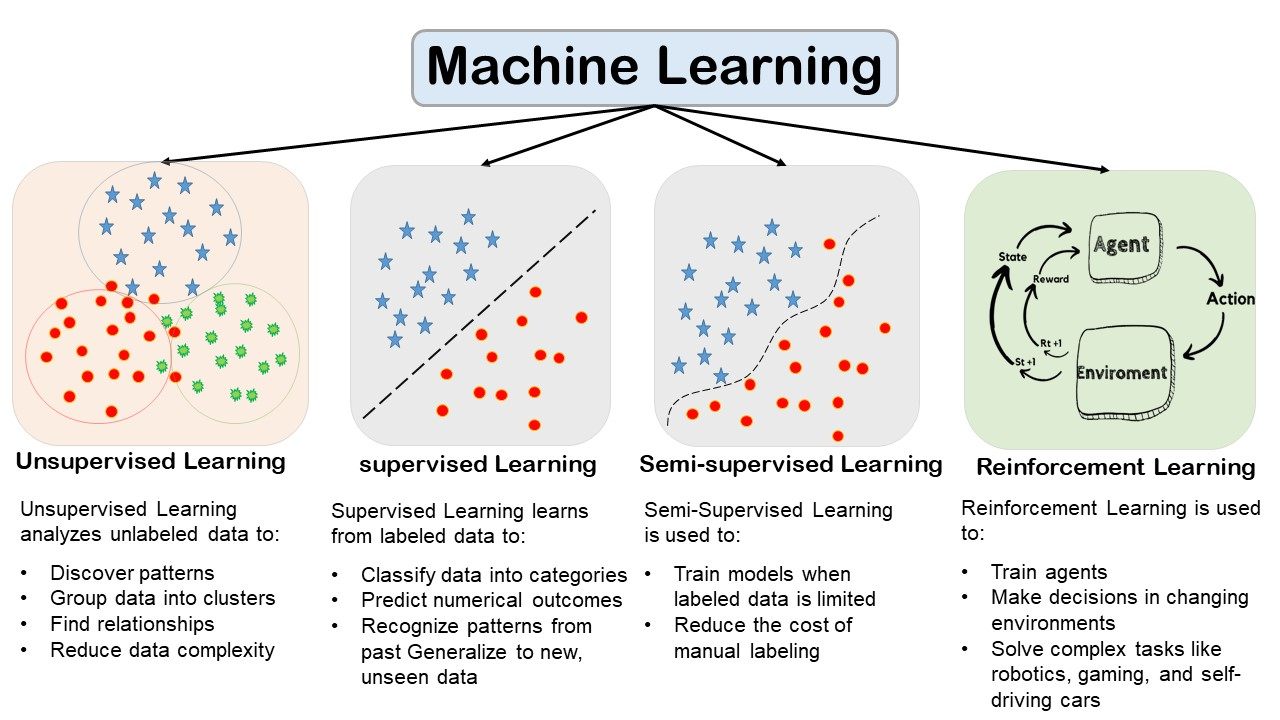
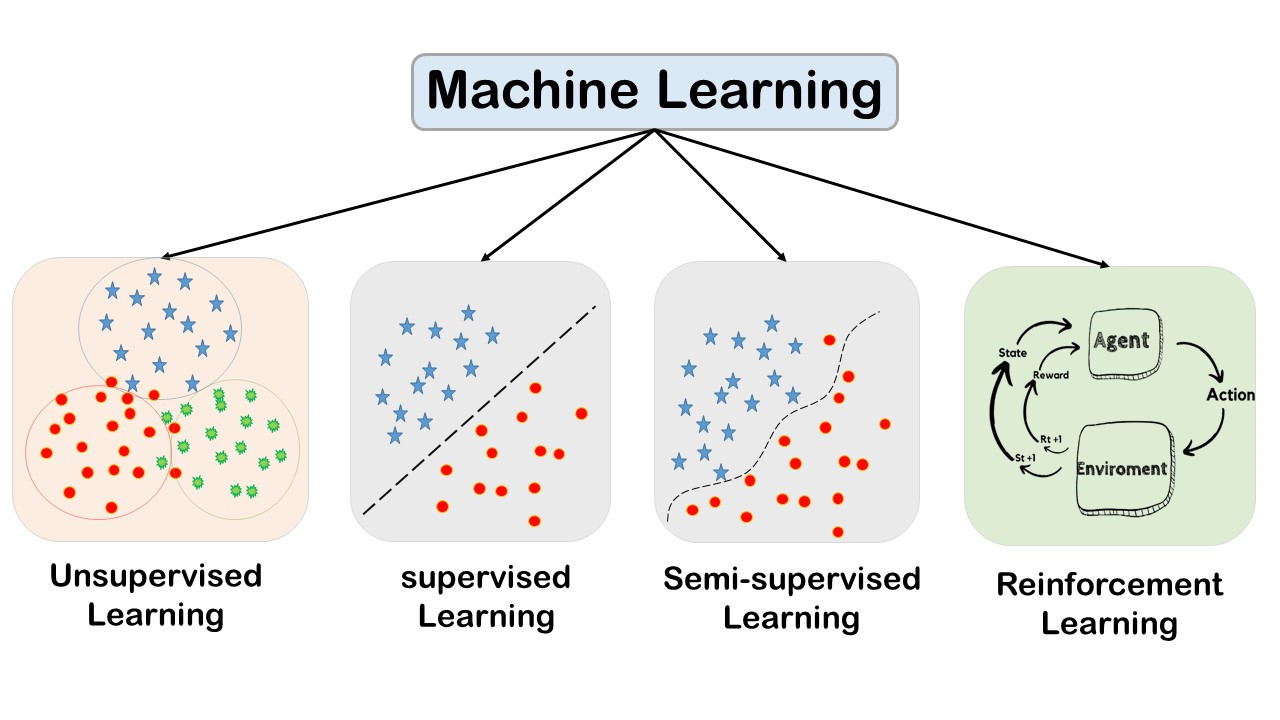
Depending on how they learn, ML is divided into four main types:
Supervised Learning:
It is the best known ML. Under supervised learning, the model is developed over a dataset whose correct answers (labels) have already been identified.
- It learns by comparing its predictions to the actual outcomes.
- Once trained, it can make accurate predictions on new data.
Example:
Estimating the price of houses by size, location and number of rooms.
Real-world uses: Email spam detection, sales forecasting, loan approval systems.
Unsupervised Learning: Finding Hidden Patterns
Here, the data has no labels. The model explores the data and discovers hidden patterns, groupings, or relationships on its own.
- Useful when we don’t know how to classify the data beforehand.
- Helps uncover insights that aren’t immediately obvious.
Example: Grouping shoppers by purchasing behavior.
Real-world uses: Market segmentation, recommendation engines, fraud detection
Semi-Supervised Learning:
In some cases, we can possess a limited number of labelled data points and a high number of unlabelled points. Both are used to construct better models in semi-supervised learning.
- Reduces the need for costly labeled data.
- Improves accuracy when full datasets aren’t available..
Example: Training a model to classify thousands of medical images using only a few expert-labeled ones.
Real-world uses: : Speech recognition, content moderation, document classification.
Reinforcement Learning:
The same-referring model is based on the rewards and consequences by which people and animals learn. The model acts within an environment, decides and learns on the outcome.
- Learns what actions lead to the best outcomes over time.
- Ideal for dynamic, goal-oriented tasks.
For example: , AI agents that can play video games or robots, operating.
Real world applications: : Self-driving cars, robots, trading systems in real-time.
What Makes ML Powerful?
There are some additional concepts involved that should be explained to see the whole picture of the machine learning functioning:
Feature Extraction: It is the identification of variables or attributes that matter the most in a dataset.
Training & Evaluation: A technique and process of training the model by the use of data and evaluating how well the model would perform on new tasks.
Continuous Improvement: ML systems can and tend to get better with time, as they analyse additional data and get feedback.