
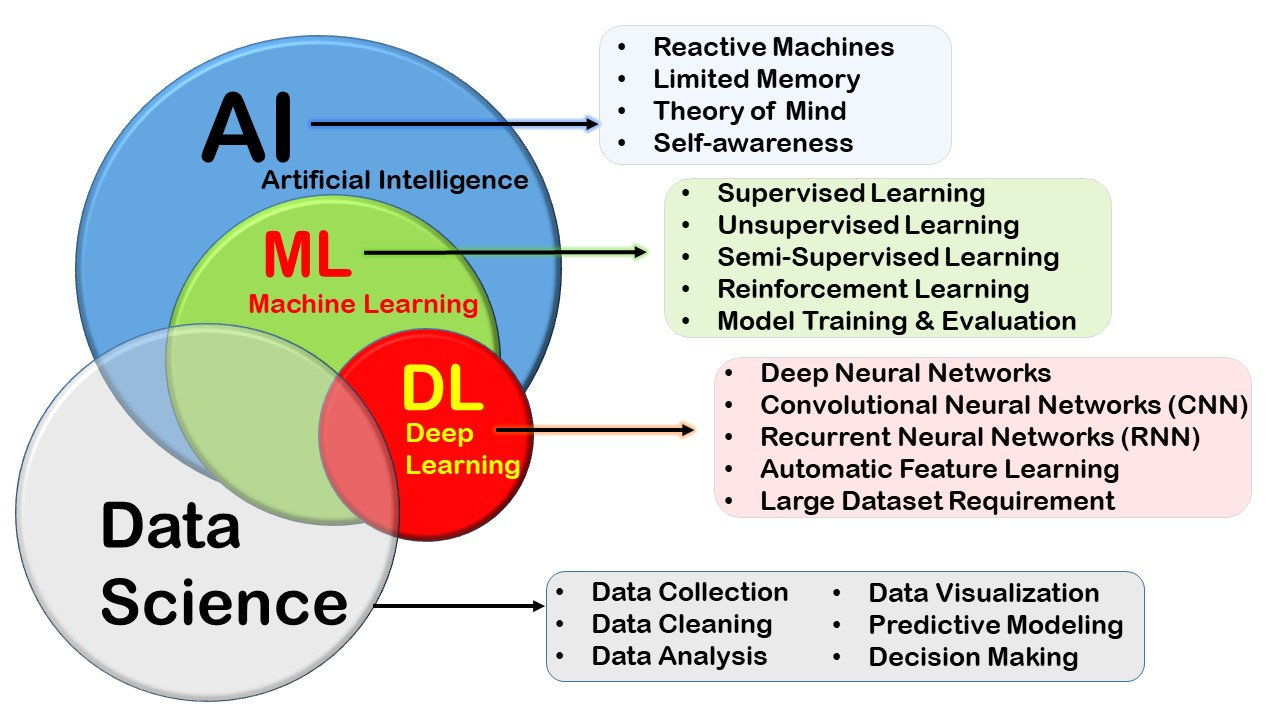
Artificial Intelligence (AI)
1. Supervised Learning
AI or Artificial Intelligence can be defined as artificial development of computer systems capable of simulating human type intelligence. The ability of AI systems to not only obey strict guidelines, but also learn, change to accommodate new information and be able to perform tasks that range between understanding language and recognizing images, solving problems and arriving at decisions with, frequently, greater accuracy and faster speed than humans, makes all that difference. These activities consist of learning, solving problems, understanding language, pattern recognition and decision-making.
Artificial Intelligence Main Features:
The human concept of AI can be categorized into different levels depending on the development through which it interprets information, how it learns and its interaction with the surrounding world. The following are the main characteristics of AI systems that take them to their basic purpose, as well as their prospects in the future.
1. Reactive Machines
These AI systems are the simplest. They respond to specific inputs with pre-programmed outputs but cannot learn from experience or store past data.
Example: Deep Blue The legendary counter by IBM, the chess-playing computer that managed to defeat a world champion by responding to the real-time positions on the chess-board.
2. Limited Memory
Such kind of artificial intelligence has a capability to store and utilize previous data to lead towards improved decisions temporarily. The majority of current AI applications can be categorized as such with systems that learn a pattern and get better as time goes on.
Example: Self-driving cars that analyze recent sensor data (like speed, nearby vehicles, and lane markings) to make safe driving decisions.
3. Theory of Mind
The more developed form of an AI where the machines would have the power to comprehend human emotions, thoughts, and intentions. This would allow AI to engage in meaningful social interactions and respond with empathy and awareness.
4. Self-Awareness
The highest and most speculative stage of AI. A self-aware AI would possess its own consciousness, emotions, and self-identity, capable of independent thought and decision-making. This level has not yet been achieved and remains a subject of ongoing research and ethical debate.
What is Machine Learning (ML)?
Machine Learning refers to a sub field of Artificial Intelligence which allows system to be able to train through dataset and make a decision or a prediction independent of any programming instruction. ML systems learn to better itself overtime by identifying patterns and learning through experience rather than using determined rules.
Key Features of Machine Learning
1. Supervised Learning
There are many algorithms that are used to training the model using labelled data in which the output and the input are known to the model to arrive at the right predictions.
Example: Predicting the price of a cryptocurrency using historical market analysis and previously recorded data trends.
2. Unsupervised Learning
It does not use labeled data and discovers the hidden patterns, groupings or structures independently.
Example: : Clustering customers based on shopping behavior..
3. semi-Supervised Learning
This technique uses a small labelled dataset and a huge unlabeled dataset to construct more compact models compared with unsupervised learning.
4. Reinforcement Learning
The system that interacts with a domain of problem and learns through experimental and error when placed in different scenarios and is given reward or punished accordingly when producing correct or wrong responses respectively.
Example: : : AI agents mastering video games or robotic movement.
What is Deep Learning (DL)?
There are many algorithms of Deep Learning but this is a particular area of Machine Learning which employs deep neural networks, network with multiple layers, commonly known as deep networks. A modeled into organization of the human brain and are highly successful in difficult tasks the Key AI applications include digital image recognition for identifying objects in images, voice or speech recognition for understanding spoken language, and natural language processing (NLP) for interpreting and generating human language.
Mostly common classifier used Deep learning
Convolutional Neural Networks (CNNs)
CNNs is an algorithm that created to process images and videos; hence they are popular in image tasks and computer vision such as facial recognition and object detection.
Neural Networks
Deep learning entails the use of inter-connected nodes (neurons) in multiple layers and that learn based on extensive volumes of data.
Recurrent Neural Networks (RNNs)
These networks are suitable on such data where sequential information is available, including time series, speech, and text. RNNs can store past data and are therefore useful in translation of language, voice aids, and others.
Automatic Feature Learning
In comparison to the classical ML approach, DL models are capable to extract valuable features automatically out of raw information without human interference necessary when selecting which set of features to use.
Large Dataset Dependency
Deep learning systems perform best when trained on massive datasets, which help the model generalize better and reduce errors.
Real-World Applications
- Facial recognition in smartphones
- A vocal assistant like Siri and Alexa
- Self-driving car vision systems
- Automated translation tools
- Medical image analysis